Showing posts with label lettuce. Show all posts

Wednesday, September 1, 2010

Must-Have Plants (Jean Ann Van Krevelen, Lisa Gustavson, Mike Lieberman)

Photo by Elaphurus on Flickr
It's harvest time! So, this segment of "must-have" plants spotlights delicious and delightful edibles of all types. These three clever gardeners, from across the nation, show you how beautiful fresh food can be ... and how you can grow vegetables, herbs and fruit in even the smallest urban spaces.


Jean Ann Van Krevelen is a big fan of fresh foods from her Portland, Oregon (Zone 8) garden. She was the main author of Grocery Gardening: Planting, Preparing and Preserving Fresh Foods, which I also co-authored. She also co-hosts the funny and popular Good Enough Gardening podcast with Amanda Thomsen on iTunes. Somehow she finds time to be social media director at Cool Springs Press. Find Jean Ann on Twitter @JeanAnnVK. Or, at her blog Gardener to Farmer.

Jean Ann likes her edibles to not only taste good, but look lovely as well. Perfect example? The purple tomatillos at the top of this post.

"I just love purple tomatillos," says Jean Ann. "In addition to being absolutely gorgeous, they produce in cooler weather than tomatoes. Their crisp, clean, slightly sour taste is ideal for fresh dishes like salads and salsas. Cook them down into a sauce and use them in Mexican or Asian dishes."

Photo by beautifulcataya on Flickr
Another favorite is 'Peacock' broccoli. "It's twice the bang for the buck," explains Jean Ann. "You can eat the little broccoli florets and the leaves. This broccoli is tender and small, so it doesn't need much cooking. Try it in salads, stir fries and grilled dishes. The leaves can be used as kale and incorporated into almost any dish. They will be a bit more tough, so blanch the leaves or saute them."


For more than 16 years, Lisa Gustavson has enjoyed spending time in the garden. In Western New York State (Zone 5b), she grows lots of unusual vegetables and fruits, mixed with flowers, throughout her charming half-acre property. Lisa is known by gardeners nationwide for her popular blog Get In The Garden. Or on Twitter at @GetInTheGarden.

Photo by Lisa Gustavson
As a young girl, Liza never particularly cared much for pumpkin pie. But now she simply loves the pie made with winter squash like this gorgeous heirloom 'Galeux d' eysines' (shown above). The beauty of this healthy vegetable is a big plus.

"The squash's sweet flavor may have won me over," she recalls. "But it was the plant's long, rambling vines and huge orange blossoms that hooked me on growing them. The sight of such a large plant unfurling from one seed is just amazing to me."

Photo by Lisa Gustavson
Fresh beans have meant "summer" to Lisa since she was a little girl. "Back then, the beans were from a local farm market," she remembers. "Now as an adult I plant different heirloom beans to eat fresh and can. I also plant varieties for drying for winter soups and stews. They're easy to grow and the beans are just beautiful."

Shown above are her stylishly spotted 'Rattlesnake' beans, green 'Vermont Cranberry' beans and purple 'Trionfo Violetto' beans. These beautiful beans elevate a simple meal into a gourmet experience.


Who says you can't grow food in small places? Mike Lieberman has grown food on a tiny fire escape in New York City (Zone 6), and a small balcony in sunny Los Angeles (Zone 10). Regardless of the size of his garden, he always eats well. Known to thousands on Twitter as @CanarsieBK, this active blogger, social media consultant and writer "walks the talk" when it comes to green living. You can learn more at http://www.canarsiebk.com/.

Have a small garden yourself? Michael recommends vegetables, fruits and herbs with a high yield. Here are some of his must-have plants for urban living.

Photo by Mike Lieberman
"A container filled with lettuces will make it to your plate quickly," explains Mike. "Plus, this plant will provide for you for many months. Growing your own lettuces helps to cut your food bills, because you'll have plenty of fresh homegrown greens to enjoy." 

The above picture shows different leaf lettuces alongside a pot of thyme as well as 'Jimmy Nardello's Sweet Italian' and 'Chili Rellenos' pepper plants on a New York City fire escape. More on lettuces.

Photo by Mike Lieberman
Herbs are a terrific food value, according to Michael. "It doesn't matter what herb you grow as long as it is one you are going to use," he says. "When you go to the store, you have to buy a bunch for 2 to 3 dollars, even when you only need a sprig. The rest winds up going to waste. Grow your own herbs, and you can harvest them as you need them. They'll last much longer too."

Mike's apple mint (left) and greek oregano (right) are growing alongside tomatoes and rosemary in the above picture. It's a perfect example of how delicious seasonings will survive growing conditions in one of the world's most urban environments.

My favorites? Over the months, you've read plant choices from some of the nation's most well-known garden writers, designers and bloggers. You may even be wondering which plants I personally can't live without. Tune in next week to find out ... when I reveal some of my favorite plants of summer 2010, complete with lots of photos. Meanwhile, don't miss these other plant picks.

Monday, July 5, 2010

Let Us Celebrate Lettuce!


"Lettuce is like conversation," said the American editor and author Charles Dudley Warner. "It must be fresh and crisp, so sparkling that you scarcely notice the bitter in it."

That pretty much sums up the abundance of lettuce and greens in our garden this year. The unseasonably cool temperatures and wet weather provided ideal growing conditions for these plants. Often the dinner salad fixings were so pretty I'd have to take a picture, which is how I got the one above.

This year, I grew everything from spotted and red romaines to arugula, mustard, tatsoi and kale. Colorful radishes ranged from the striking 'Long Scarlet' to 'Purple Plum' and pastel 'Easter Egg.'


I'll sow seeds for salad greens, wherever I can. Here's a bed where I tossed different seeds together for radicchio, lettuces, kales, mustard greens and more. It's a wild look, which also works well for containers.

Eventually, I let the greens form flowers as the temperatures rise. Then I'll pick the flowers for a vase. So, we can snip off edible, spicy flowers right at the table. And the flowers left in the garden help to self-seed new plants for next year.


Some greens are pretty enough for a prominent position in your ornamental beds. This 'Leonardo' radicchio is a favorite. The leaves add a beautiful, slightly bitter taste to salads. As you can see above, this plant grows nicely next to baby kales and other greens.


Don't have a lot of space? Lots of greens like these butterhead lettuces grow nicely in a small pot. As temperatures rise, move these cool-weather plants into partial shade and water well. Lettuces prefer rich, well-drained soil that has plenty of organic matter.


If I could only pick one green to grow, I'd pick 'Forellenschluss' romaine lettuce ... called "speckled trout" lettuce in English. I sow this Austrian heirloom directly into my raised beds, in neat rows.

This variety handles cool temperatures and heat well. In fact, it's the last salad green to bolt in my gardens. You'll love the way this delicious lettuce holds its shape well with salad dressings, and it's beauty will impress your friends. If you can't find this delightful variety at your local garden center, try Seed Savers Exchange.

Fall Greens: There's still time to plant lettuce for the autumn. Simply, count back from your average first frost date and allow enough time for the lettuce to grow before then. Most varieties take about 30 to 60 days to grow, and you can pick the leaves while they're still small. Some varieties perform well with a little frost, as long as the ground hasn't yet frozen.

With a little effort, you can enjoy all types of greens well into the fall.

Want more information?
Here's lettuce growing tips from Clemson University. Plus, tips for growing radishes. Happy growing.

Monday, June 14, 2010

Part III - Even More Experts With Must-Have Plants


A suburban garden in New Jersey. An apartment balcony in California. Acreage in northwest Ohio. These gardeners may enjoy the outdoors in different ways, but they all know plenty about plants. Here are their "must-have" plants for this year...


Like gardening blogs? There's a good chance you've read Kylee Baumle's Our Little Acre. Her award-winning blog takes place in a rural northwest Ohio garden. Recently, it was awarded not one, but several 2010 Mouse and Trowel awards.

Somehow this dental hygenist also finds time to write Gardening by the Book and co-write Soil Sisters, as well as write for Cool Springs Press GREEN Program. On Twitter, you can find this busy woman at @OurLittleAcre.


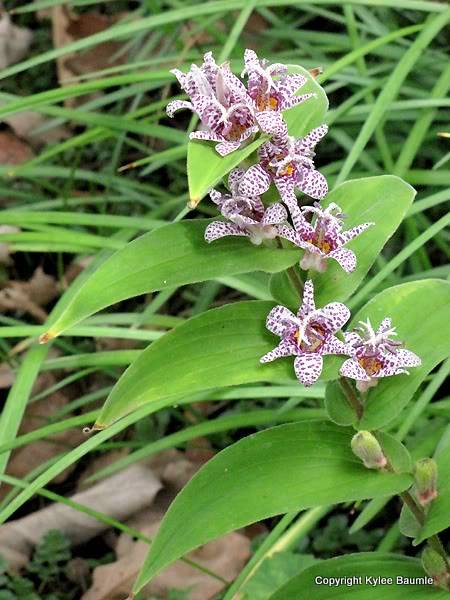
This summer Kylee is thinking about plants "that offer a little out of the ordinary," such as Toad Lily (Tricyrtis sp.) suitable for Zones 5 to 9. Toad Lily 'Miyazaki' is shown above, while Toad Lily 'Tojen' is pictured at the top of this blog post.

These orchid-like flowers bloom in autumn, "when nothing much besides mums and asters are really going to town," says Kylee. "Plus, Toad Lilies come in various colors, and the foliage varies from cultivar to cultivar. Some leaves have spots or stripes. Some are golden in color. And some are traditional green. A particularly nice feature is that they add color to shade gardens and are in the mid-height range."


Her second choice is an edible one ... corn. "Where I live, in northwest Ohio, corn is as common as the dirt it grows in," explains Kylee. "Summer just wouldn't be summer without sweet corn. My favorite variety is the white and yellow bicolor, but I'm a big fan of the pure white, such as 'Silver Queen.' " (Shown above.)


"In August, I make a meal out of just sweet corn," she says with a laugh. "I slather the corn with butter and salt and can eat six ears or more at a time. Most people gain weight over winter, right? For me, it's in August." (Shown above is 'Ruby Queen' corn, which she grew in 2008.)


Gardening in a smaller space? You still have plenty of options. Just ask Fern Richardson, who writes the award-winning blog Life on the Balcony. Also a 2010 Mouse and Trowel award winner, the blog has won praise from Sunset Magazine and others. On Twitter, Fern can be found at @LifeOnTheBlcny.

Some favorite plants Fern likes growing on her California balcony...


The first one is ... Aeonium. "There are so many interesting varieties of Aeoniums, you really can't go wrong," says Fern. "I particularly like the variegated and black varieties like the one in this picture. Their floral-like rosettes provide year-round interest and ask for only the tiniest bit of attention in return."


"Another favorite is chocolate mint," says Fern. "This plant is nearly indestructible, and yet so tasty! I love using the leaves in teas, and they're also a yummy addition to banana bread."

When she makes banana bread, Fern adds 2 to 3 tablespoons of dried chocolate mint with the dry ingredients.


In the New York Metropolitan Area, award-winning landscape and design consultant Susan Cohan is busy managing Susan Cohan Gardens and serving on the Board of Directors for the Association of Professional Landscape Designers. That is... when she's not writing her thought-provoking blog Miss Rumphius' Rules or tweeting as @SusanCohan on Twitter.

Susan admits it's not easy to choose only a few "must-have" plants. But she did agree to provide "two finalists culled from a long list of favorites." As she explains, "I won't give a plant the thumbs up until I've actually grown it. So even from a landscape designer's perspective, both are absolute winners!"


Her first choice is 'Red Romaine' lettuce. The plant really stood out among the rest when she recently designed and planted a large vegetable garden.

"I chose plants based not only on their cool weather preferences," says Susan. "But also for the beauty of their foliage. Unfortunately, the flats were only labeled as 'Red Romaine'. But this unnamed red romaine was my favorite of all the lettuces. It is a striking plant that added a punch of color to a very formal vegetable garden and would look great mixed with ornamentals as well."


Her second choice is the 'Abalone Pearl' peony, shown above.

"The peony has a single clear salmon pink bloom held upright on fernlike foliage," explains Susan. "I hardly ever buy plants for myself anymore. And I even thought about this when I saw the plant in the nursery. But as I was ready to leave, I started to feel remorse at leaving it there. So I had to buy one."

She hasn't regretted her decision yet.

Hear Susan Cohan discuss landscape design (and design in general) on Nest in Style.

Like this? Don't miss these other stories:
Must-Have Plants
Must-Have Plants (Part II)

Favorite Winter Plants (Maine Containers)
Favorite Winter Plants (Northern Idaho)
Favorite Winter Plants (Canada)
Favorite Winter Plants (North Carolina)
Favorite Winter Plants (Western Washington)

More expert plant suggestions to come soon!

Tuesday, March 16, 2010

Seed Advice, Heirloom Seeds, Plant Lists


Purple carrots, blue corn, spotted lettuce and rose pink beans. These are just some of the unusual and delicious vegetables you can grow from seeds in your garden.

Nest in Style Podcast: Eager to learn more about seed starting? Have questions about heirlooms and hybrids? Or, just want more professional garden design tips? Don't miss this Nest in Style podcast episode and hear from three nationally-recognized gardening experts: Nan Sterman, Chris McLaughlin and Rebecca Sweet.

What I'm Growing: While you're listening to Nest in Style, why not look over some of the seeds that I'm growing in the garden this year? You'll see they aren't your average grocery store vegetables.


Beans - "I was determined to know beans," wrote Henry David Thoreau in the late-19th century. And I know just what he means. I love growing beans from seeds. Here are a few beans I've grown in my garden already or that I'm trying this year for the first time.

Bean, Purple Podded Pole - Shown in picture above; purple heirloom bean of northern European origin. Turns green when blanched.

Bean, Ideal Market Pole - Very productive, stringless green pole bean, shown in picture above from harvest 2009.

Bean, Red Swan Bush - Beautiful dusty, red-rose snap bean, which I'm eagerly trying for first time this year. Just think how lovely it will look with purple podded pole beans.

Bean, Pencil Pod Wax Bush - Stringless yellow wax bean that is great for freezing or canning. Trying this one for first time. As you can probably tell, I prefer my beans in unusual colors.

Bean, Painted Pony Bush - Dual purpose bean with long stringless green beans, which later grow to become attractive dry beans in brown and white. These dry beans are highly recommended for soups and stews. I'm trying this variety for the first time, because I'm eager to taste and compare both types of beans.

Bean, Dragon's Tongue Bush - Wax bean with cream-colored pods and thin purple stripes, which disappear when blanched. Below is a picture of some beans I grew in 2009.


I'm growing a lot more than beans, of course. Below are just a few vegetables I'll sow in my garden this year.

Carrot, Cosmic Purple: Bright purple carrots with shades of yellow and orange. Trying for first time.

Carrot, Jaune Obtuse Du Doubs: Lemon-yellow carrot with fine, sweet taste. Trying for first time.
 
Carrot, St. Valery: French variety dating back to at least 1885, handsome bright, red-orange carrots. Trying for first time.

Carrot, Tonda di Parigi: Round in shape, these orange, 19-century Parisian heirloom carrots are 1 to 2 inches long. Ideal for rocky soil. Trying for first time.

Radish Helios: Yellow, olive shaped radishes; Baker Creek Heirloom Seed Company reports this heirloom came from Alzbeta Kovacova-Pecarova of Kosice, Slovakia (very near the village where my grandfather was born!) Trying for first time with great delight.

Radish, Purple Plum: Bright-purple skin with crisp white flesh. Trying for first time.

Radish, Long Scarlet: Long and slender, bright red radish that dates back to pre-1870s.  Radish that looks a bit like a carrot -- How cool is that! Trying for first time.

Plus, I can't wait to try ...

Corn, Blue Jade: Steel-blue cobs that become jade-blue when boiled. Dwarf plants that grow 2 to 3 feet bear 3 to 6 ears of corn. One of the few sweet corns that can be grown in containers. Trying for first time.

Squash, Lebanese White Bush Marrow: Rare variety of cream, oblong summer squash, which is delicious baked or fried. Trying for first time.

Speaking of squash, I loved this winter squash I grew last year:

Squash, Musquee de Provence: Averaging 20 pounds, this French variety of winter squash has orange, blue and green colors that ripen to a deep, rich brown. The deep orange flesh is great for baking.

Salads will be made with greens such as these:

Lettuce, Merveille Des Quatre Saisons (Marvel of Four Seasons): With a name like that, how could I not grow this French variety? This bibb letuce has ruby-red leaves with tightly folded green hearts. I've grown this tasty heirloom several years.

Lettuce, Forellenschluss: This old Austrian heirloom is a favorite of mine. The green romaine leaves are speckled with deep rose, and stand up well to salad dressings.This lettuce is as beautiful as it is delicious.

Arugula, Apollo: Productive variety of domesticated rocket; high in vitamin C; excellent in salad mixtures.


That's not all I'm growing this year either. They'll be more cool-season and warm-season plants, which I'll start inside from seeds, direct seed out in the garden, or buy as transplants from local nurseries or farmer's markets. We're lucky here, for instance, to have many unusual varieties of tomatoes, peppers and eggplants available for purchase.

Whatever you decide to grow this year, just remember, it's important to rotate your vegetable crops each year. Want more information? Read the Seasonal Wisdom post on crop rotation.

Happy growing!